Bangle Binge

IMG_1081

We’ve just toured the elaborate, sprawling Meenakshi Temple complex in Madurai, Tamil Nadu, India. Meenakshi is an incarnation of the Hindu goddess Parvati. This temple is unusual in that it is devoted entirely to the female deity, rather than to her male consort, Shiva. 

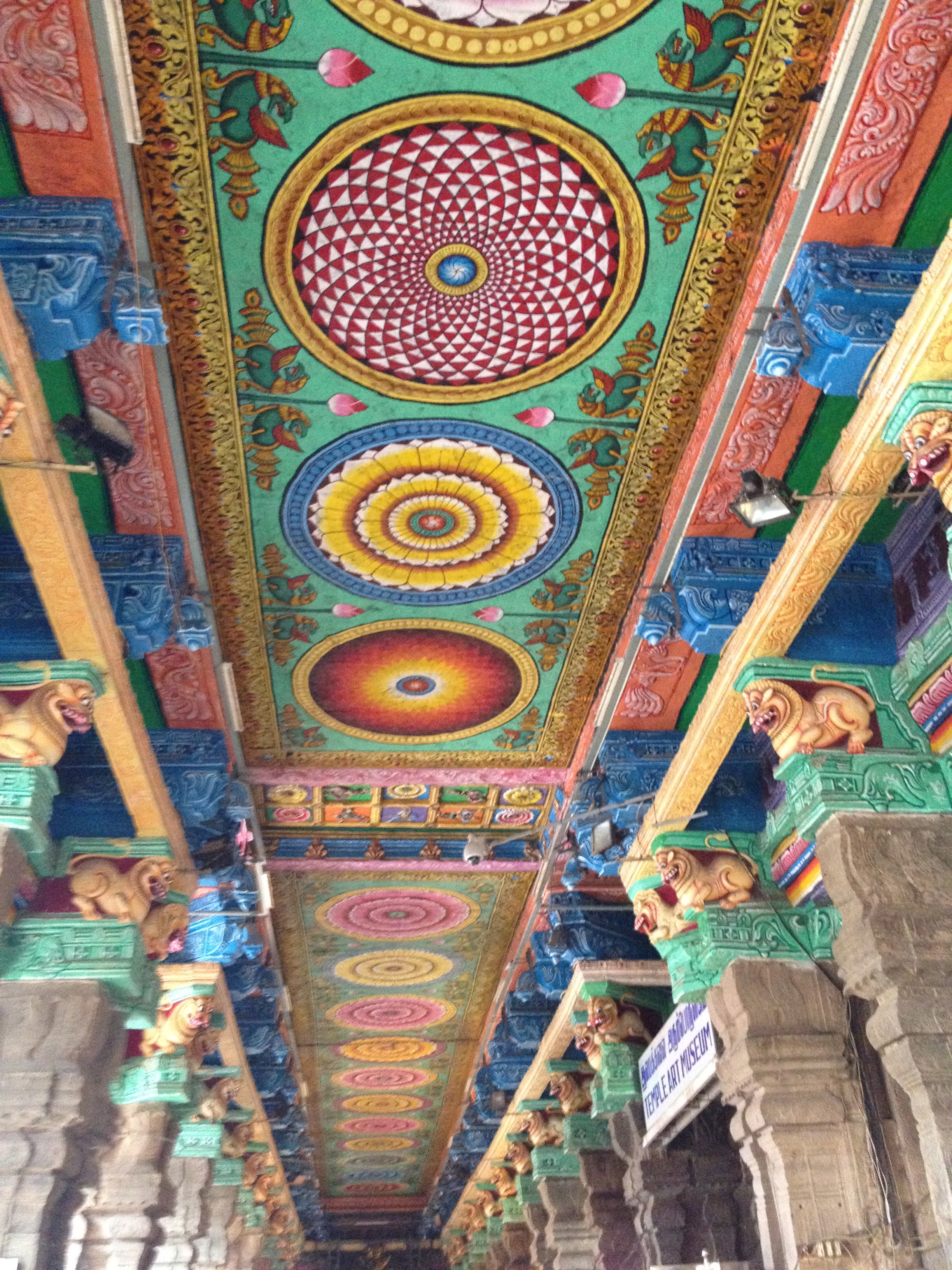
Meenakshi Temple’s towers teem with minutely detailed sculptures and its corridors are emblazoned with bold designs and patterns in a kaleidoscope of colors.  Heading back through the outer corridors of the complex we pass numerous stalls overflowing with multi-colored, gold-sprinkled kitsch: statues and figurines of all kinds, scarves, wall-hangings, umbrellas, rainbow-hued framed and unframed drawings of Hindu gods and goddesses, carved boxes, jewelry and more. My partner draws my attention to a small stall containing nothing but floor to ceiling stacks of thin bracelets in every color imaginable; a bangle shop! I haven’t seen a woman or girl in India without several bright, shiny rings of color circling each wrist.  I’ve wanted to purchase a few of these ubiquitous adornments as souvenirs for myself and also as gifts for my girlfriends back home.  The petite, traditionally-clad shopkeeper and his assistant have watched us stop and look, and they have already sprung into action. Armed with bangles in each hand, they approach as I step over the low curb separating the main corridor from the tiny shop. My partner stays firmly put on the other side. I know by now that I won’t have the luxury of time or space to examine the shelves on my own and then serenely decide on a course of action, as I would back home. But I’ve crossed the threshold now and there’s no turning back.

In an impressively honed, rapid-fire relay, the shopkeeper directs his assistant to pull out specific bangles from the thousands on display. The assistant then whisks them to his boss, who presents them to me for about three seconds each, speedily exchanging them through this same relay – in reverse – until I show enough interest in something to delay the action momentarily. I decide to eliminate items based on color first; no lime green or fiery red for me, thanks. Maybe no lemon yellow, either. As soon as I indicate my disinterest, those particular bangles disappear from the shopkeeper’s hands and replacements in the remaining colors appear in their place. Lovely blues, deep greens, vibrant purples and rich oranges. I nod and murmur my approval.  The shopkeeper instantly halts the relay with the assistant.  He holds one of the “approved” bangles up to me and points to my hand; we’ve entered a new phase. He starts to slide the bracelet over my fingers and it goes as far as my knuckles and stops. I try contorting my hand into various positions without success. The shopkeeper demonstrates how I should hold my hand, with fingers extended and thumb folded under to create a smaller circumference. I haven’t quite got it, and he grasps my wrist and shakes, trying to release the tension from my hand and fingers.  Finally the bangle clears the now red and swollen knuckles of my left hand. The same thing happens with the next several bracelets, until finally one snaps in half as we both try to force it over the hump. I apologize profusely and turn red, feeling like some kind of ham-handed freak.  

I try to pantomime that I’d like to pay for the broken bracelet, but the shop-keeper and his assistant have seamlessly shift gears into what I’ll call the “sizing-issue” phase of the transaction. I can’t understand a word they’re saying, but before I know it the shopkeeper’s open palms are laden with a whole new set of approved-color bangles, now apparently in jumbo size.  We try again and this time I demonstrate near perfect bracelet-fitting posture.  Most of the hard, shiny circles of plastic summit the peaks of my knuckles without incident. I am relieved, wiping the sweat off my face with my free hand and cracking a smile. The shopkeeper and his assistant respond in kind with smiles and gestures of approval. I decide to wear two gold-flecked royal blue bangles out as the assistant carefully wraps the rest in recycled newspaper, the swirls of Tamil script making it just as pretty, and more special, than any pricey gift-wrap.

As I dig around in my change purse for the few rupees that will seal the deal, I feel a personal sense of accomplishment. On the face of it we have completed a simple business transaction, but for me at least, there is more to it than that. On a trip where almost all of my transactions have been mediated through “my man,” handling this one on my own has been a small, but satisfying achievement. 

As I step back over the low curb to rejoin my companion, I raise my hand to the two gentlemen in the shop, and my bangles tinkle sweetly in salute. 

The Road from Kodaikanal

IMG_1174On the tight, steep, winding road heading back down the mountain from the hill station town of Kodaikanal, our driver, Ramki, is praying again. My partner and I spent the last two days enjoying the fresh air and extraordinary views from 7,000ft. in the Western Ghat mountains of Tamil Nadu, South India.  We hiked local trails, skidding downslope alongside cascading waterfalls where village boys bathed; climbing up along stone walls topped with bands of steely eyed macaques heading out to forage.  We bent low and whispered while searching for the elusive and massive gaur, or Indian Bison, which negotiates its precipitous mountainside terrain with a grace belying its size.  We learned about the unique and fragile habitat known as the Shola, the sub-tropical montane evergreen forest, which houses not only the gaur (“gauer”) but also elephants, the grizzled giant squirrel, and a flower that blooms once in twelve years.  In the mountains we found respite both from the heat of the lowlands, and from the stunning sensory overload that is urban India.  We must return to the city, however, and this two-hour drive down the mountain is the first order of business.

Driving in India – even on straight, level roads – is total madness.  Traffic rules, such as those pertaining to signaling, stopping, passing, staying at a particular speed or keeping to a given lane, either don’t exist or are ignored. So I appreciate Ramki’s requests for divine intervention.  He is a devotee of Shiva, and although we did survive the drive up the mountain two days ago, I still have some doubts about the inclination of a God who goes by “the Destroyer” to keep us from hurtling off a cliff at any given bend. My partner and I duck involuntarily as we nearly collide with one of the jam-packed, fume-spewing buses that tilt and bounce along the narrow, pot-holed pavement. We cringe as the projectile vomit of one of its ashen-faced occupants bursts out of a barred window and arcs momentarily before splattering into the valley far below.  Ramki is unfazed. He seems to harbor no doubts at all about Shiva’s intentions. He drives with his head stuck out the window now, because the windshield has fogged up completely, and for some reason that we can’t fathom he doesn’t want to use the wipers or stop the car to clean the windshield. Instead, he leans way out and twists his head around the side of the car so that he can, presumably, see where we’re going. Ramki’s hands, at least, are still firmly holding onto the wheel … and he prays.

He prays aloud each time we pass another tiny roadside temple, complete with multi-colored gopuram, the typically South Indian tower marking a temple gateway.  Carved with minutely detailed scenes from Hindu mythology featuring that particular temple’s presiding god or goddess, the tower rises in progressively smaller layers, like a fantastical wedding cake.  Such vividly colored scenes also decorate the Shiva postcards Ramki has clipped to his sun-visor. Just in case Shiva decides to take an unannounced vacation day, however, Ramki has a miniature statue of the Virgin Mary stuck onto the car’s dashboard, and topping it all off there is Jesus, swinging serenely from the rear-view mirror.   I notice that Ramki has wound a garland of jasmine flowers around Mary’s feet for the drive down.  (As it turns out, the owner of the company he drives for is an Indian Christian, so perhaps Ramki feels obligated to acknowledge his boss’s religion.)  At the large south Indian Hindu temples we recently visited, just such fresh, fragrant jasmine garlands adorned the hair of many female pilgrims, who often have the garlands blessed by a temple priest.  I’m moved that the Christian Mary rates this lovely and traditional adornment in Ramki’s view, and impressed that these diverse religious trappings share Ramki’s physical and spiritual space so comfortably.

As we round a bend and another sheer drop-off comes into view, I set my camera to video-mode and settle in, pleased that Jesus, Mary and Shiva are all on board for the ride.

Security, Schmurity, or the Confounding Nature of Indian Airport Security

Airport security in India is a perplexing combination of over-the-top and inexplicably lax. The first time I noticed something was different was when we had to put our baggage through an x-ray screener in order to exit the airport terminal upon arriving in India. I mean, if we’d had anything worth blowing up hopefully it would’ve been discovered before we got on the plane that we just got off of. But speaking of pre-flight security, get this: you can’t even step foot inside an airport terminal in India unless you are a ticketed passenger. If your tickets and boarding passes are approved by the security guys at the door and you actually make it inside, then you have to get in line to put your check-in bags through an x-ray machine. If they pass this test, you will have to tag your bags and get in the ticket counter line to check them in. At the ticket counter you will have to tag every carry-on item you have before you proceed to security and the gate. This is a vital step, as I discovered at the Chennai international airport when I almost missed my flight to Frankfurt because the ticket counter lady had neglected to give me tags for my carry-on bags. “Madam, they will not let you on the plane without tags,” the piqued security-line guy said to me. It was after 1am, my flight was already boarding and I was desperate to be on it. Finally, while I stood at the conveyer belt and sweated, he gave me substitute tags from some other airline and I made a run for the gate, where I simply waved my boarding pass under a scanner and got on the plane without a pair of human eyes ever looking at my bags. I had asked if there was a separate security-line for business class passengers, something which is quite common in the states. No, I was told, everyone must wait in the same line. Back I trudged to my place in the long line, which had been kindly held for me. Within minutes I noticed a couple who had been in the Business class check-in line with me earlier. They had walked up to the head of the security line just after me, and were now being let in ahead of everyone else, saving them about 15 minutes of waiting-time. I guess it depends on whom you ask and what kind of mood they’re in at the moment.

On one of several domestic airline trips I took within India, I counted nine times that my flight documents were checked by various security people between arriving at the airport and getting on the plane. First there was the entering-the-airport-terminal-check, then the x-raying-your-check-in bag-check. This was followed by the ticket-counter-check. Next, the entering-the-general-security-line-check, and then the women’s-separate-wanding-and-pat-down-line-check. There was the arriving-at-the-gate- check, and, within a few feet, the leaving-the-gate-for-the-shuttle-to-the-tarmac-check. Next was the walking-up-the-stairway-to-the-plane-check, and finally, there was the stepping- into-the-airplane -check. I was incredibly thankful that I had invested in one of those hang-around-your-neck travel document holders, making it much easier to produce the documents every couple of minutes while moving through the airport. As for that pat-down, after placing your bags onto the x-ray conveyer belt, every passenger proceeds either to the right or left to their gender-appropriate line to walk through the metal detector and get wanded/patted-down. This procedure was always done behind a screen by a woman for the women.

So, there’s all this seemingly extreme security on the one-hand, but in other ways security at Indian airports appears much more laid-back. I never saw anyone have to take off their shoes, place their separately bagged liquids and gels in a bin, or empty their bottle of water before going through security. On another domestic trip in India, at Madurai Airport I had already proceeded through a security checkpoint upstairs towards my gate when I found that my flight was delayed. I had time to kill and was hungry, so I went back downstairs and tentatively asked the security officer at the checkpoint if I could possibly buy some food from one of the airport vendors and bring it back upstairs. He waved me through as if to say, “of course, why do you ask?” I was relieved but also surprised, as you generally can’t move back and forth through a security checkpoint at a U.S. airport.

But perhaps most importantly, they actually serve food on Indian domestic flights, and it’s good!

Mumbai Mitzvah

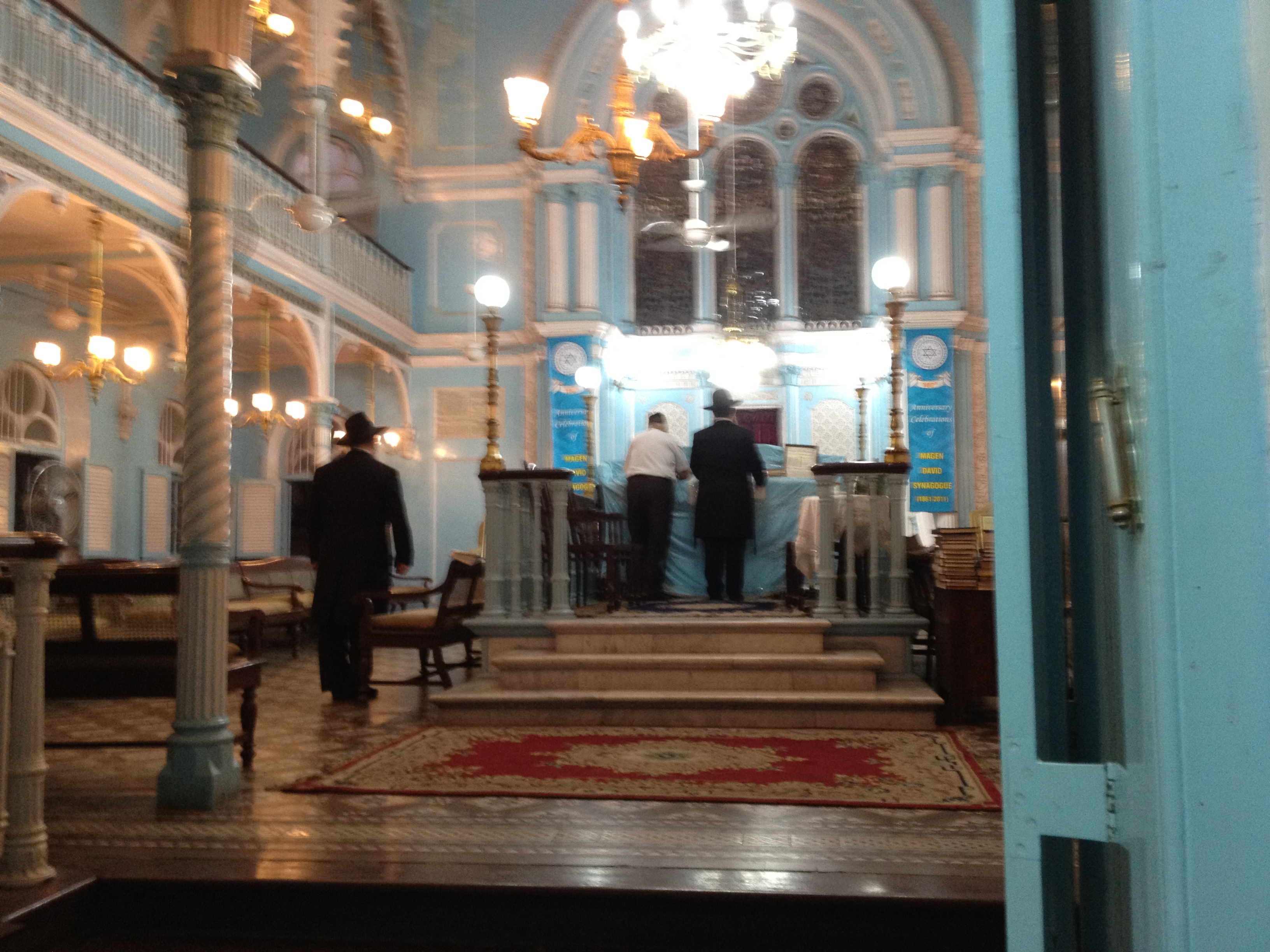
IMG_1224Between the sprawling slums and the crushing traffic it’s taken us nearly two hours to drive from the north end of Mumbai, near the airports, to the Colaba neighborhood in the south of the city, where the major tourist sites are located. I’ve needed a bathroom for at least the last half-hour and know I won’t make it the further twenty minutes or so to the historic Gateway of India, where we’re headed. Finding decent public toilet facilities in India has proven to be a major feat, but a quick location-based Google search indicates a possible hit–a café in our vicinity. The driver lets M and me off at a plaza of sorts and we ask the first person we see for directions. The guy does the classic Indian head-wobble— indicating a definite yes-no-maybe—while pointing toward a side-street, so we set off that way. While M ambles ahead down the street I notice several young men standing next to a metal detector in front of a building entrance.  These machines are so ubiquitous in Indian cities–and even more so here in Mumbai–that I take no special notice. I ask them if they know this particular café, but they too, are stumped. Out of the corner of my eye I spot it—a Star of David on the jacket of one the young men. I look up at the building and it dawns on me; it’s a synagogue, and these guys are… Indian Jews!  The pain in my bladder reminds me that permanent organ damage is probably only minutes away and I find myself yelling “I’m a Jew!” with a mixture of revelation and panic.

Jacket-guy, who’s been the main talker, is momentarily stunned by my outburst and before he has time to respond I continue in what I hope is a slightly less deranged tone. “I mean, uh, you probably have a toilet, right? Cause I really am…a Jew. Do you think I could…ya know?” I’m jerking my head as nonchalantly as possible toward the temple to indicate what a completely normal, logical next-step this is: Jew.Synagogue.Toilet. I figure there’s no need to disclose that I am, more precisely, an agnostic half-Jew who’s been in a synagogue maybe half-a-dozen times in her life and barely knows a matzo from a mitzvah. I’m in extremis, after all, so I’m sure there must be some kind of amnesty available, like when the Catholic Church pardoned that rugby team that crashed in the Andes and ate their dead people (cannibalism ordinarily being frowned upon by the Vatican).

I obediently dig out my passport for jacket-guy’s inspection. I don’t know how he plans to verify my Jewishness from this document, but I know this is not the time to ask.  He glances at the document and apparently decides that I am unlikely to blow up the building and in unison all three men direct me to go around the metal detector, in the door and then up, all the way up, several floors up, to find the ladies’ toilet. They’re still gesturing skyward as I sprint for the door.

As I begin stair-climbing I see a very few men in traditional Orthodox garb conducting prayers in the main sanctuary, and I realize that the Friday night service is in progress.  I step gingerly on tippy-toes on the old staircase, admiring the delicate woodwork of the banister and the lovely sky-blue and creamy-white color scheme. Abruptly my primitive brain interrupts this touristic reverie with a shrill hiss: “Focus! There’s simply no time!” I re-clench—so hard that I fear I’ve pulled a muscle—before continuing up past the high-altitude ladies’ gallery, where I spot three or four women attempting to keep their passel of hyperactive children under control. Trying vainly to be inconspicuous, I frantically scour every hall and doorway for signs of an impending toilet.  One more set of stairs ascends into semi-darkness, and I know it’s my last hope. On the top floor a barren, sunken hallway leads to the very hind-quarters of the building where two cramped, unlit closets—each containing a tiny 19th century toilet—beckon. I don’t bother to look for a light-switch or close the door before dropping my pants.

On the way down I have time to consider the serendipity of it all, and to sneak a couple of photos.

IMG_1219

IMG_1220

I had hoped to visit the town of Cochin—in the state of Kerala—on this my first trip to India, partly because I had heard about its ancient Jewish settlement, but unfortunately scheduling wouldn’t allow it. So to have stumbled upon this beautiful synagogue in the middle of India’s largest city feels like kismet. I recall reading somewhere that Mumbai’s Jewish community—about 250 years old—has been seriously diminished over the years since Israel’s creation, as more and more of its members emigrate; I make a mental note to do some more research when I get home. As I step outside I thank the young man with the jacket heartily. He smiles and sends M and me off with “Shabbat Shalom!” “Uh…Shabbat Shalom!” I reply with only a moment’s hesitation, pleased that I haven’t completely blown my Jew-cred in the end.

We start back up the street and in the fading sunlight I turn to snap a photo. Like the proverbial lotus rising from the muck, the synagogue’s beleaguered sky-blue facade and soaring stained-glass windows struggle to fend off encroaching grime from the street below.

I’m thrilled, moved and a little bit saddened by my unexpected encounter with the Jews of Mumbai, but I know this is one agnostic, secular half-Jew who won’t soon forget the meaning of mitzvah.